
A self-published psychological thriller about a Dallas housewife whose perfect life is rotting from the inside just landed a seven-figure publishing deal AND a TV adaptation with the creator of Black Cake attached.
I have been watching Drowning in Paper Flowers quietly take over the internet, and honestly, I am not even a little surprised that Hollywood came sprinting.
Marissa Jo Cerar is developing E.L. Westbury’s domestic thriller Drowning in Paper Flowers for television, with Jenna Bush Hager and Ben Spector of Thousand Voices and Universal Global Television attached to the project.
Who Is E.L. Westbury?
E.L. Westbury describes herself with the kind of specificity that immediately tells you everything you need to know about her:
“E.L. Westbury is a wife, mother of five (three humans and two fur babies), and coffee enthusiast. Even though her writing is full of snaps, crackles, and pops, she’s a hopeless romantic at heart. When she isn’t writing, she’s trying to convince her husband to watch The Notebook for the hundredth time, laughing at her kids’ attempts to teach her Gen Z slang, or curled up on the couch covered in dog kisses. She lives in Texas but often escapes to Colorado, where she finds peace in wildflowers, red wine, and mountain air.”
Westbury self-published the novel in December 2024, and what followed was one of those publishing stories that proves organic word-of-mouth still has the power to change everything.
The book attracted significant attention and eventually sold to Atria Books in a seven-figure North American deal. UK and Commonwealth rights sold to Orion, with translation rights acquired in six languages. Atria and Orion relaunched the novel on August 11 with a new bonus chapter.
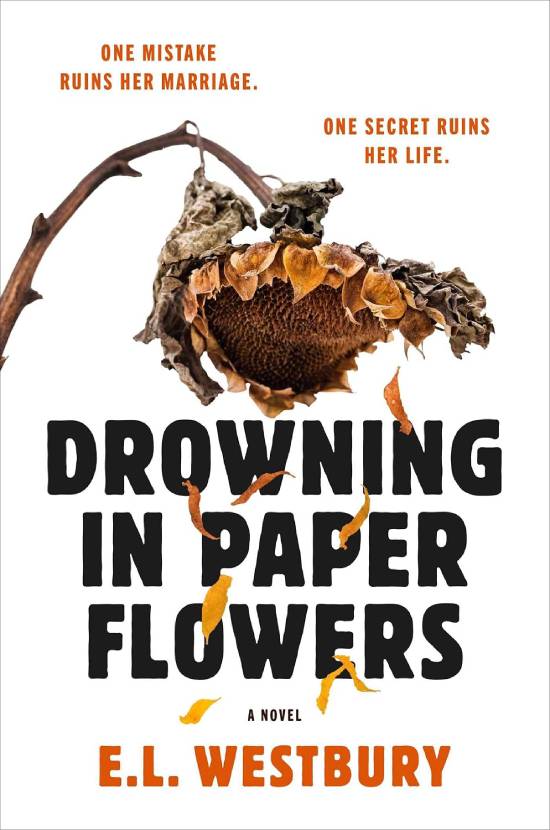
What Is Drowning in Paper Flowers About?
The novel is structured around a devastating gap: the difference between what Ruby Powell’s life looks like from the outside and what it feels like to actually live it. Westbury spells out both versions right on the page, and the contrast is the hook from which the whole story hangs.
The official description makes the architecture of the novel immediately clear:
THE LIE: Ruby Powell is perfect. She lives in her dream home in the most affluent neighborhood in Dallas. She’s a doting mother, a devoted wife, and a respected member of her community. She takes pride in serving as the president of both her son’s elementary school PTA and her daughter’s high school soccer Booster Club. Her kids adore her, and her husband is still her best friend after eighteen years of marriage.
THE TRUTH: Ruby Powell is a full-figured, middle-aged housewife, living in a house she’s grown to despise. She detests her husband, who is engaged in a long and ongoing affair. Her teenage daughter loathes her, and her sweet, gentle six-year-old son suffers from PTSD after being the victim of a kidnapping as a toddler.
Beneath Ruby’s polished exterior lies a woman struggling with dissatisfaction in her marriage, a sense of inadequacy as a mother, and an addiction to anti-anxiety medication due to recurring nightmares.
When Ruby can no longer separate the truth from the lies of her carefully created facade, she faces a nightmare involving an affair, a dead body, and a realization that her entire life has been built on deception.
Readers have been evangelical about it. One reviewer described the plot as “complex and intricately woven,” praising Westbury for giving the story time to build and smolder before the real chaos arrives.
The psychological and unreliable narrator elements are handled with real craft.
Ruby doesn’t just lie to the people around her; she lies to herself, which makes her both maddening and deeply sympathetic as a protagonist.
When the nightmares begin bleeding into her waking life, the reader is as unsure as she is about what is real. That kind of sustained unreliability is very difficult to pull off, and Westbury does it with considerable skill.
The Showrunner Who Gets This Exactly Right
Bringing Marissa Jo Cerar as the creative lead on this adaptation is no accident. That detail makes this announcement genuinely exciting.
Cerar began her career as a writer-producer on Netflix’s 13 Reasons Why, Fox’s Shots Fired, and Hulu’s The Handmaid’s Tale. She is an NAACP Image Award and two-time Humanitas Prize-winning writer for the two series she created and served as showrunner: ABC’s Women of the Movement and, most recently, Hulu’s Black Cake, her adaptation of Charmaine Wilkerson’s bestselling novel.
Black Cake best demonstrates why Cerar is the right person for Drowning in Paper Flowers. That series follows a Jamaican woman whose death reveals a lifetime of secrets to her children, and it’s built on the same architecture as this novel: the gap between what a woman presents to the world and what she carries privately.
Cerar knows how to take a story about a woman who has hidden the truth of her own life and translate it into television that is both emotionally devastating and compulsively watchable.
No network or streaming platform has been announced as of writing. No cast has been confirmed as well.
Be There Before The Facade of Ruby’s Life Cracks
Drowning in Paper Flowers was relaunched with its new bonus chapter on August 11, meaning it is available right now, fresh from the press, and waiting to be read before anyone has a chance to tell you what happens.
Go in as cold as possible. The lie/truth structure in the opening pages tells you immediately what kind of novel this is, and the slow process of watching Ruby’s carefully maintained facade develop real fractures is best experienced without any spoilers in your peripheral vision.
And when you finish that four-word final sentence—the one that keeps readers awake—you’ll understand exactly why Marissa Jo Cerar, Jenna Bush Hager, and Universal Global Television saw a television series in these pages.
More Book Adaptations: