
Miramax is developing a feature adaptation of Everything We Never Said, Alloy Entertainment’s YA romantic thriller novel from debut author Sloan Harlow, with Amy Andelson and Emily Meyer aboard to write the screenplay.
Arianna D’Andrea is overseeing the project for Miramax, with Alloy’s Leslie Morgenstein and Elysa Koplovitz Dutton producing.
This is a book that was built for the screen from the very beginning, and the team adapting it clearly knows exactly what they have.
Who Is Sloan Harlow?
Sloan Harlow has been interested in writing since she was very young — and Everything We Never Said, published in 2024, is her debut novel.
She is now a New York Times and USA Today bestselling author of two novels—Everything We Never Said and its follow-up All We Lost Was Everything—with a readership that found her entirely through word of mouth and BookTok before the publishing industry fully caught up with how big she was becoming.
The trajectory of Everything We Never Said is worth understanding properly, because it tells you a lot about why Hollywood is paying attention.
Alloy Entertainment’s book division developed the novel. Yes, the same company behind The Vampire Diaries, Netflix’s You, Gossip Girl, and the Pretty Little Liars franchise. It was then licensed to G.P. Putnam’s Sons for publishing, with Alloy retaining film and TV rights.
For a debut novelist with no prior platform, that is a remarkable achievement, earned entirely by the book itself.
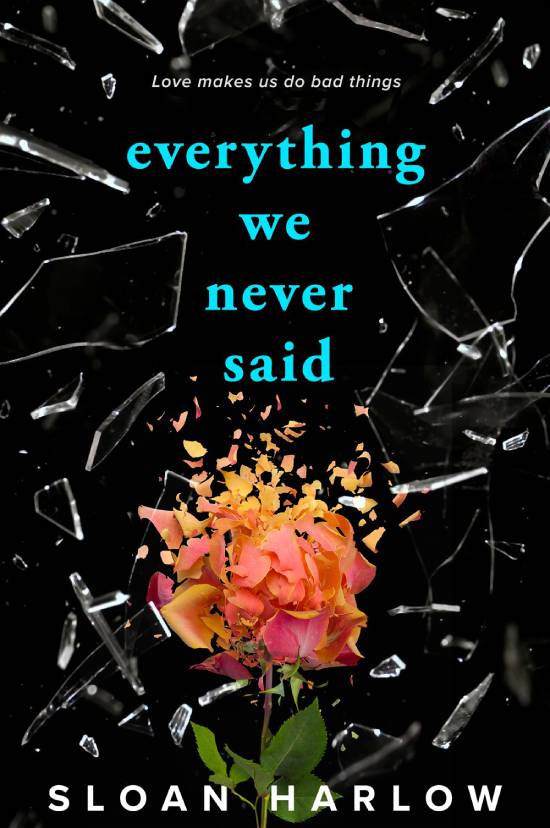
What Is Everything We Never Said About?
The novel announces its emotional stakes on its first page. Ella Graham is a high school senior walking back into school months after a car accident that killed her best friend Hayley—an accident that Ella was driving through, drunk, with no memory of what happened.
The guilt she carries is not abstract. It is with her in every hallway, every class, every moment she sees someone who knew Hayley.
The official description lays out the central complication with devastating simplicity:
It’s been months since the accident that killed Ella’s best friend, Hayley, and Ella can’t stop blaming herself. Now Ella is back at school, and everywhere she looks are reminders of her best friend—including Sawyer, Hayley’s boyfriend. Little by little, they grow closer, until Ella realizes something horrifying… she’s in love with her dead best friend’s boyfriend. Racked with guilt, Ella turns to Hayley’s journal, hoping she’ll find something in the pages that will make her feel better about what’s happening. Instead, she discovers that Sawyer has secrets of his own and that his relationship with Hayley wasn’t as picture-perfect as it seemed.
The diary is where the story shifts from a guilt-driven romance into something considerably darker. What Ella finds in those pages reframes everything she thought she knew about her best friend, about Sawyer, and about the night of the accident itself.
Harlow’s own prose captures the emotional texture of Ella’s grief with real precision. Walking back into North Davis High, Ella narrates:
“I feel like I’m not returning as Ella, but as Shadow Ella, the living ghost girl. The thought feels like a paper cut on my heart. I wish I were a ghost. Maybe then I could stretch across the realms and actually still talk to Hayley.”
Kirkus Reviews described it as “a psychological thriller that leaves her audience guessing until the last page.” Booklist praised Harlow for “thoughtfully depicting complex emotions such as grief, depression, love, guilt, and more without losing sight of the twisty plot.”
The Team Bringing It to Screen
The choice of Amy Andelson and Emily Meyer as screenwriters is what gives this adaptation real credibility. For YA fans in particular, the names will be immediately recognizable.
Andelson and Meyer wrote and created the Netflix series Trinkets, which earned three Emmy Awards, including Outstanding Young Adult Program. They have also adapted The Great Gatsby for director Jon M. Chu, and previously wrote screenplays for Step Up 3D and other Chu projects.
They are writers who understand the specific emotional register of YA storytelling—the particular intensity of teenage grief and desire and moral confusion—and who have demonstrated the ability to translate that register convincingly to the screen.
Miramax, meanwhile, has a long history of prestige literary adaptations. The combination of Alloy’s IP expertise and Miramax’s production reach gives this project a serious infrastructure behind it.
No director or cast has been announced. The project is in early development, with the screenplay still being written.
What Hayley’s Diary Already Knows
The thing about Everything We Never Said is that Hayley is everywhere in it—in Ella’s guilt, in the hallways of North Davis High, in the pages of the diary that changes everything—and yet she is never on the page alive. She exists entirely in the negative space that her death created. That is a genuinely difficult thing to construct in a novel, and Harlow pulls it off.
The film version will have to make a choice the book never does: whether to show us Hayley at all. This decision alone will define what kind of adaptation this becomes, and whether it preserves what makes the novel so specifically haunting.
It’s a question worth sitting with before Andelson and Meyer answer it for you.
More Book Adaptations: